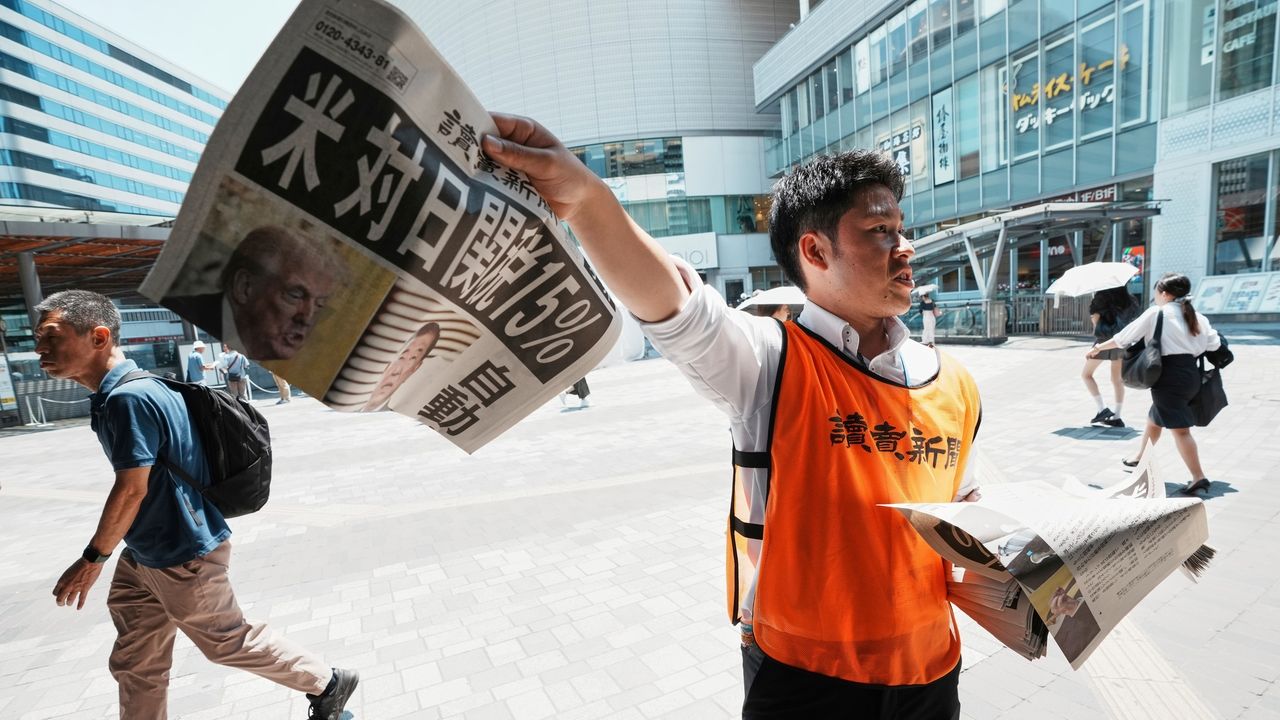
WASHINGTON — President Donald Trump has been rather vocal about Japan’s purported pledge of $550 billion for investment in the United States, as part of a new trade framework. This figure, though astounding, remains subject to negotiation and is not quite as assured as it might seem.
“Japan is putting up $550 billion in order to lower their tariffs a little bit,” Trump remarked on Thursday. “They put up, as you could call it, seed money. Let’s call it seed money.”
A White House official, insisting on anonymity, revealed that the terms are still being hammered out and not yet etched in stone. The aspiration, it seems, is for the $550 billion fund to be deployed at Trump’s discretion. However, formal documentation is yet to surface. According to Japan External Trade Organization, direct investment into the U.S. economy already exceeded $780 billion in 2023.
Japanese trade negotiator Ryosei Akazawa has expressed a keen desire for a written joint statement to prevent misunderstandings. “If we find differences of understanding, we may have to point them out and say ‘that’s not what we discussed,’” Akazawa noted.
Interestingly, it appears that the U.S. released its version of the deal while Japanese officials were airborne, returning home. Akazawa did not elaborate on the $550 billion’s specifics but indicated that further details would depend on how investment agreements unfolded. Japan’s Cabinet Office noted the involvement of state-affiliated financial institutions like the Japan Bank for International Cooperation.
The U.S. administration, looking ahead, plans to channel funds into vital sectors such as critical minerals, pharmaceuticals, computer chips, and shipbuilding. Moreover, Japan is expected to purchase 100 airplanes from Boeing and rice from American farmers. Treasury Secretary Scott Bessent stated the agreement would undergo quarterly evaluations.
Bessent also warned that disappointment on the U.S. side could revert tariffs to 25%, particularly impacting the automotive industry. “And I can tell you that I think at 25, especially in cars, the Japanese economy doesn’t work,” Bessent pointed out on Fox News’ “The Ingraham Angle.”
Despite American assertions, Akazawa denied that such quarterly reviews were part of the discussions. He emphasised nothing about enforcement mechanisms came up during his extensive meetings in the United States.
As for agricultural matters, Japanese officials have no current plans to increase their import quota on U.S. rice, with Agricultural Minister Shinjiro Koizumi highlighting that decisions will be made independently by Japan.
This trade framework has provided President Trump with fodder to claim victories in trade, even though the tangible economic impact remains elusive. His commerce secretary, Howard Lutnick, hinted that Japan’s deal might pressure other nations, such as South Korea, to negotiate with the U.S. Meanwhile, Trump, presently in Scotland, anticipates a meeting with European Commission President Ursula von der Leyen to discuss further trade matters.
“Whatever Donald Trump wants to build, the Japanese will finance it for him,” Lutnick enthused on CNBC. “Pretty amazing.”
This whole affair, with its blend of optimism and uncertainty, encapsulates the intricate dance of international trade.