Contents
A Rather Tumultuous Day on Wall Street
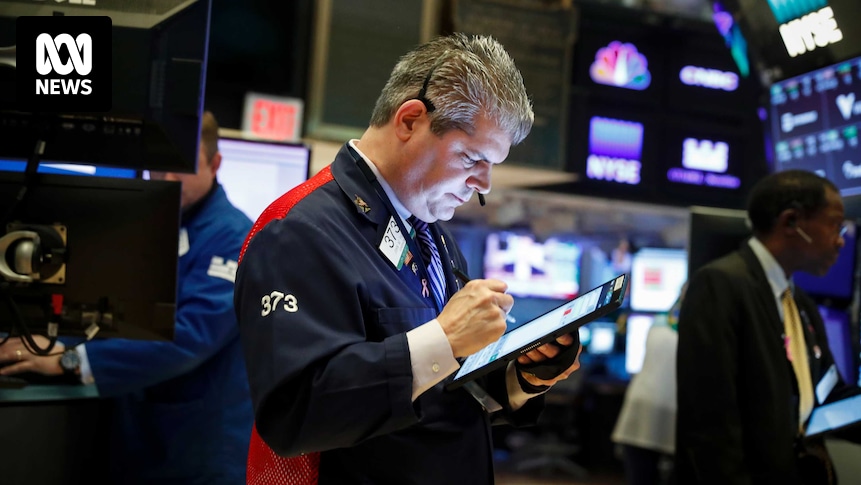
While the Trump administration prepared for its tariff barrage, Wall Street found itself in retreat. Friday’s trading screens were awash with red. The S&P 500, Dow Jones, and Nasdaq all took notable hits. The S&P 500 dropped 2%, whilst the Dow Jones was down 1.7%, and the tech-centric Nasdaq found itself haemorrhaging 2.7%.
European Markets: Bracing for Impact
Europe, unfortunately, found itself in America’s tariff line of sight. Nonetheless, its markets were relatively less bruised. The European exchanges collectively dipped by a distressing 1%. Meanwhile, the UK’s FTSE managed to escape with just a minor 0.1% dent.
Anticipation in Australian Markets
As the US markets swooned, futures trading pointed to a similar fate Down Under. The ASX 200 was expected to drop more than 1% as morning trading commenced.
Fears of Stagflation Grow
Concerns over stagnation and inflation—stagflation, in other words—were rife. An alarming survey indicated consumer fears about rising inflation had climbed to two-and-a-half-year highs. Furthermore, consumer spending appeared softer than expected, while PCE inflation (the Federal Reserve’s preferred measure) saw an increase from 2.6% in February to 2.8% in March.
Treasury Yields and Currency Reactions
Stagflation fears pressured US Treasury yields, and the US dollar weakened against both the Euro and Japan’s Yen. However, the Australian dollar didn’t quite enjoy this effect, finding itself a victim of the prevailing “risk-off” sentiment. It slipped by 0.3%, albeit eked out a small gain over the week overall.
Commodity Markets: A Mixed Reaction
Concerns over economic growth placed downward pressure on oil prices. Brent crude slipped by 0.5% to $US73.6 a barrel. Nevertheless, on the weekly front, prices were indeed higher. Meanwhile, gold offered a glimmer amidst the uncertainty, climbing nearly 1% to a record high of $US3,084—its 18th record high this year.
Other Commodities: Copper and Iron Ore
In other news, copper prices edged upwards, whereas iron ore slipped a marginal 0.3% to $102.20 per tonne. This dip followed a strong week, during which iron ore outpaced other major commodities, boasting a 3.5% increase.
Prominent Economic Analyst’s Take
In the words of ING’s Chief International Economist, James Knightley: “Today’s data is only inflaming stagflation fears. We’re moving in the wrong direction, and tariffs threaten higher prices. Consequently, it’ll constrain the Fed’s capability to execute further interest rate cuts.”
With so many moving parts and potential changes on the horizon, one might argue it’s a rather precarious time for the financial markets globally. Transitioning through the turbulence will require a careful watch on both data releases and policy shifts.