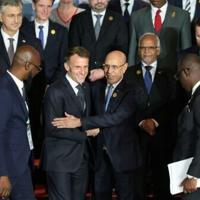
On Tuesday, European and African leaders made a firm commitment at the close of a summit focused on enhancing trade and more effectively addressing irregular migration, aiming to boost ties between their continents.
Over the course of two days in Luanda, Angola, discussions yielded a comprehensive declaration highlighting Europe’s keen interest in securing critical minerals and Africa’s pressing need for employment opportunities and economic growth.
Contents
– A rich continent –
“Africa is blessed with an abundance of natural resources essential for both energy and digital transitions,” remarked European Council President Antonio Costa during the EU-African Union summit’s closing remarks. However, he emphasized, “Africa’s greatest treasure is its human capital and youth.” Developing value chains that promote employment across the continent is therefore paramount.
With its crucial minerals and potential for energy, Africa has become a strategic battleground. Notably, China, the United States, and Russia are vying to strengthen ties with the continent.
– Showing of support –
From Europe, prominent figures such as Germany’s Friedrich Merz, Poland’s Donald Tusk, and Spain’s Pedro Sanchez attended. Analysts suggested that a robust turnout was vital to demonstrate Brussels’ commitment. Representing Africa were leaders including South Africa’s Cyril Ramaphosa, Kenya’s William Ruto, and Djibouti’s Ismail Omar Guelleh.
– Summit’s sombre note –
The event was partly overshadowed by a European rush to improve terms of a US proposition for resolving the Ukraine conflict. Countries from the EU held an unscheduled meeting on Monday. Travel issues kept Denmark’s Mette Frederiksen, Luxembourg’s Luc Frieden, and EU foreign policy head Kaja Kallas from attending. Notably, leaders like Merz, France’s Emmanuel Macron, Italy’s Giorgia Meloni, and European Commission President Ursula von der Leyen departed early.
According to Alex Vines of the European Council on Foreign Relations, “The summit has been mostly perfunctory,” with “many assertions that the Africa-Europe partnership is of high priority.” Yet, the focus on Ukraine by European nations serves as a reminder that perhaps it isn’t.
– Agreements and initiatives –
Despite this, Portugal’s foreign minister Paulo Rangel told AFP that the presence of many delegates sent a clear message. Describing the summit as a “success,” he lauded agreements on mobility and migration. “Africa and Europe must collaborate if they wish to influence the global stage,” he added.
On the occasion of marking 25 years of EU-AU relations, the summit followed a G20 meeting in South Africa, where a US boycott highlighted geopolitical rifts. These issues took centre stage in a 10-page joint declaration addressing “rising uncertainties in trade policies and tariff volatility” as challenges for the global economy.
Both continents, affected by US tariffs, are committed to securing strategic minerals. Furthermore, African nations have pushed for investments that generate local value beyond mere resource extraction. Europe’s pledge was to support their industrial growth and regional market integration.
– Global Gateway Initiative –
Europe is backing its ambitious Global Gateway initiative, aspiring to counterbalance China’s influence with large infrastructure plans. Angola, the host nation, is home to the Lobito corridor, a significant railway project funded in collaboration with the USA. This project aims to connect mineral-rich areas in the Democratic Republic of Congo and Zambia to the Atlantic coast.
European Parliament Vice-President Younous Omarjee noted, “We now have something very concrete to offer. That’s what we lacked in the past.” The EU also committed to aiding Africa with irregular migration issues and the repatriation of failed asylum seekers, a concern among EU’s 27 nations.
Additionally, both parties urged an immediate halt to hostilities in Sudan, strongly condemning “the atrocities committed in El-Fasher,” recently captured by the paramilitary Rapid Support Forces.
ub/ho/jhb
For further reading on these topics, you might explore the Global Gateway and the Lobito Corridor projects.