Saudi Arabia is shaking up its wealth game.
Back in April 2016, they rolled out “Saudi Vision 2030”, setting their sights on catapulting Saudi Arabia into the world’s top 15 economies by 2030. They’re shooting to bump the Public Investment Fund (PIF) assets from $160 billion to almost $1.9 trillion. Plus, they aim to leap from 25th to somewhere in the top 10 on the Global Competitiveness Index. Not too shabby, right?
Contents
01
Reimagining wealth: Goodbye oil, hello innovation
The days of leaning solely on oil are winding down. Saudi Vision 2030 shows the government’s push to ditch reliance on the black gold, aka oil. Large AI models are now the talk of the town. Computing power’s the new “oil”, and Saudi’s all in.
Fast forward to the end of 2023, Saudi’s messing around with 22 active data centers. Expectations are to hit 62 soon. Keeping with the trend, during Trump’s second visit to Saudi in May 2025, AMD joined hands with a local AI firm, Humain. (For a deep dive on Humain, see “Semiconductors in the Middle East, the Future is Bright” on ICViews.)
Come August 2025, Humain kick-started building data centers in Riyadh and Dammam. Humain CEO Tareq Amin hinted they’ll switch the lights on by mid-2026. By 2030, they’re planning an impressive 1.9 gigawatts of capacity. Meanwhile, the Stargate project eyes 4.5 gigawatts for the U.S. alone.
02
Saudi’s sandy shores: The next big tech frontier
NVIDIA and AMD, tech’s big guns, didn’t come alone. Even Intel’s Pat Gelsinger popped in for a chat on semiconductors and AI. And they’re not the only ones sniffing out Saudi’s burgeoning market.
ICViews dished out juicy tidbits on data center investments since 2021. Turns out, plenty of these centers are a Saudi-China love affair, initially serving cloud needs across the Middle East.
2025 was Tencent Cloud’s year for its first Middle Eastern venture, pledging over $150 million. This might just be the beginning of Saudi’s tech transformation.
03
Why tech firms are eyeing Saudi Arabia
Energy bills got ’em hooked. Data centers guzzle energy, making U.S. giants sweat over rising costs. They project data centers might use up 12% of U.S. electricity by 2028. Saudi’s state-owned Saudi Electricity Company offers a sweet deal, meeting massive industrial demands with surplus capacity.
It’s not just the power prices—there’s ample infrastructure in the works. They’re laying down thousands of kilometers of transmission lines and throwing in new nuke plants to boot.
Don’t forget the electricity rates. In the U.S., they’re rising fast. Conversely, Saudi promises costs between 5 to 8 cents per kilowatt, making data centers smile wide.
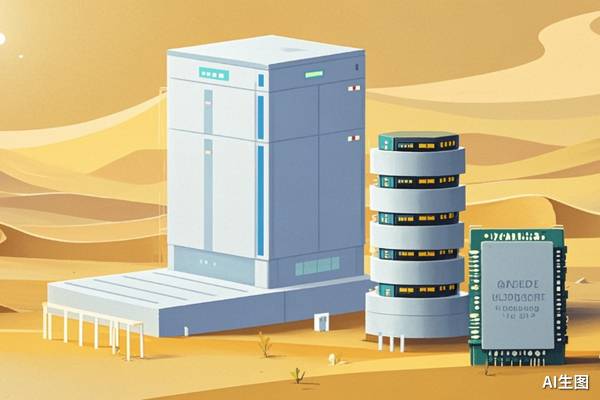
Plus, no green spaces to mind. With the desert’s barren landscapes, data centers settle comfortably without worrying about disrupting lush nature. It’s a win-win for tech giants looking to expand seamlessly.
Not to say they’re anti-green. In line with Vision 2030, Saudi’s charging ahead with renewable energy projects, reducing its oil shackles.
04
Building more than just data centers
Saudi wants more than to be a “power-richer”. They’re beefing up in science. Enter King Abdullah University of Science and Technology (KAUST), a hub of innovation since 2009. They’re churning out cutting-edge research in semiconductors and much more.
One standout project from KAUST? Chips that stack 41 layers high, crushing the competition, all while trimming energy use. KAUST’s aligning research with innovation, having set up a cool 750 million Saudi Riyals deep-tech fund.
05
Saudi Arabia’s path ahead
By 2024, Saudi’s GDP hit $1.09 trillion. They’ve also got their eyes on the tourism pie, projected to balloon to $110.1 billion by 2033.
According to the Global Innovation Index of 2024, they’re riding high, now in the 47th spot. There’s significant buzz in China about investing here too.
Yet, as with all good stories, caution’s wise. Many boast ties to the royal circle, but sometimes wind up spinning wheels. When diving into Saudi investments, keeping both eyes open is key.
This deep dive originally appeared via “Semiconductor Industry Insights” by Liu Qian, published on 36Kr with permission.