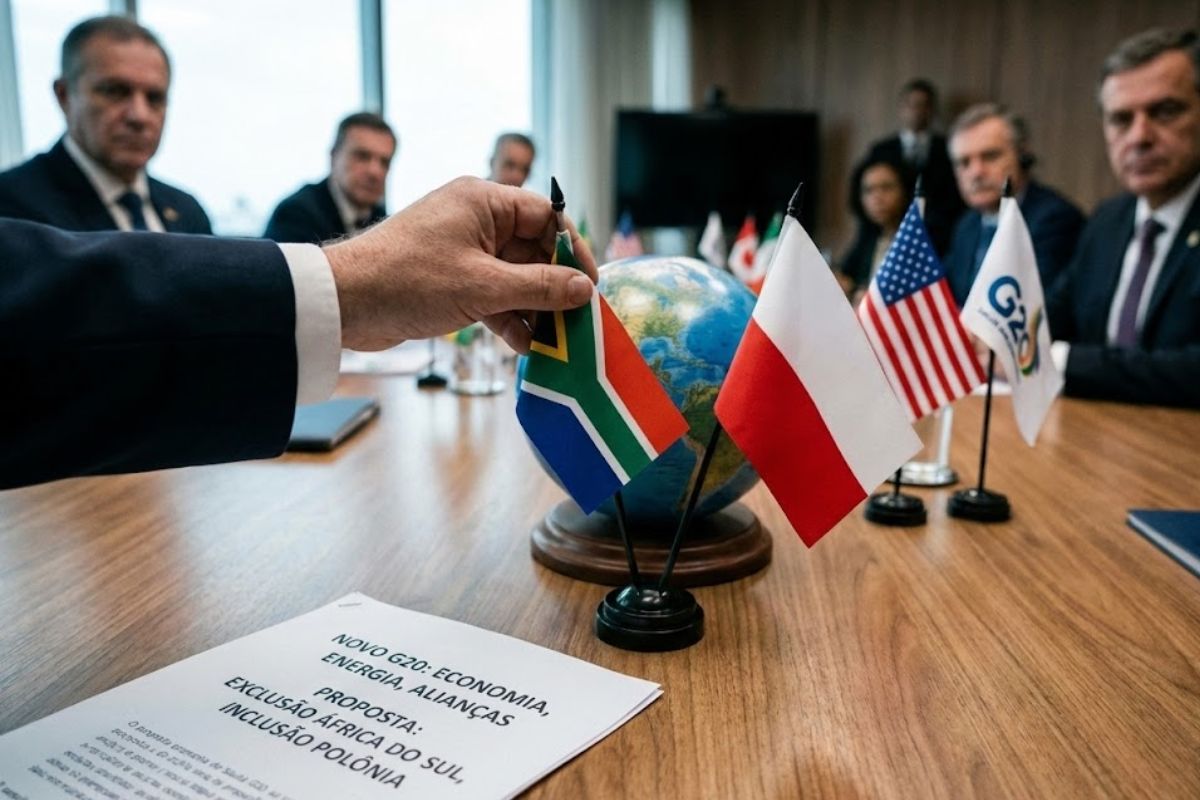
The Trump administration has unveiled its strategy for leading the esteemed G20. South Africa, regrettably, finds itself without an invitation for the forthcoming meetings. Meanwhile, Poland is warmly welcomed as a fresh participant in this circle of the world’s significant economies. It’s evident that Trump intends to reshape the G20 to suit American interests, carefully selecting allies and setting priorities.
Contents
Trump wants a G20 focused on economy, energy, and technology
The Trump administration proposes a “new G20” centered on three main axes. Firstly, reducing regulatory hurdles, aiming to cut bureaucracy in investments and enhance the flow of strategic capital and business for the United States.
Secondly, there’s an emphasis on strengthening energy supply chains. This comes amidst global competition for gas, oil, and novel energy solutions. The goal is to build partnerships with nations offering stability and reducing reliance on politically divergent regions.
The third focus is on stimulating new technologies and innovation. Topics include the digital economy, technological infrastructure, and research investments. Under this vision, the G20 should become a platform for countries ready to adopt standards akin to US models.
By prioritizing these pillars, the administration indicates a shift away from environmental and social debates that dominated previous summits.
Poland’s new role in Trump’s G20
In this revamped setup, Poland is hailed as a “natural partner” of the United States. Once a nation hidden behind the Iron Curtain, it now proudly stands among the world’s 20 largest economies.
According to Secretary of State Marco Rubio, “Poland’s success emphasises future-focused progress.” This stronger American-Polish alliance is poised to boost Warsaw’s prosperity, with the nation already being one of the US’s closest European allies.
Poland’s recent political shifts, including electing right-wing nationalist Karol Nawrocki, align well with Trump’s approach, notably on security, energy, and border policies.
The boycott of South Africa
The White House has made its stance against South Africa part of a wider diplomatic strategy. Trump accuses the South African government of unfounded persecution of the white minority and land expropriations without compensation.
This narrative justified the US boycott of the G20 summit in Johannesburg in November 2025. Rubio, formalising the exclusion, declared South Africa would not receive an invitation during Trump’s presidency.
Interestingly, the conflict with Pretoria intensified during South Africa’s G20 presidency, with Washington consistently blocking topics and negotiations.
Criticism of South African policy
Washington’s rhetoric against Pretoria has escalated with Rubio’s latest remarks. Accusations of racism became a central theme, along with criticisms of economic mismanagement.
Rubio also disparaged South Africa’s G20 agenda, calling it “an exercise in resentment” for prioritising climate change and diversity. For Trump, the G20 should focus on economic growth and trade agreements advantageous to the US.
Next steps for the “new American G20”
The inaugural G20 meetings under the US presidency, including countries like Brazil, are set for December 15 and 16, 2025, in Washington. A series of thematic meetings will follow throughout 2026 to cement Trump’s vision.
The grand finale is planned for a summit at Mar-a-Lago, symbolising American leadership. Although other G20 members have not officially commented on the exclusion of South Africa and Poland’s invitation, intense debates on participation rules are anticipated.
Poland’s Foreign Minister, Radosław Sikorski, endorsed the invite, asserting Poland’s rightful place as a global economic force.
Despite South Africa’s veto, the G20 composition remains with 19 countries, the European Union, and the African Union. Yet, Trump’s reshaping pressures allies to reconsider partnerships and alliances.
And how do you view this “new G20” strategy? Could it fortify the group or spark a larger crisis among global partners?
- BNDES releases funds to support Aena in modernising airports, potentially creating thousands of jobs by 2028.
- Nubank is eager to become a recognised bank by 2026, seeking licensing from the Central Bank.
- PicPay has committed to refunding approximately R$ 1 million in insurance, promising to end tied selling practices with INSS.
- Uber launches a luxurious air travel category, offering helicopter and seaplane flights for those seeking exclusivity.