In an unexpected turn, the administration of US President Donald Trump has sparked considerable debate by halting Harvard University’s ability to enroll international students.
Although the action is dressed up as a measure for national security and accountability, a plethora of voices—including economists, educators, and lawmakers—warn that it could wreak havoc on America’s economic interests and international reputation.
Trump vs Harvard
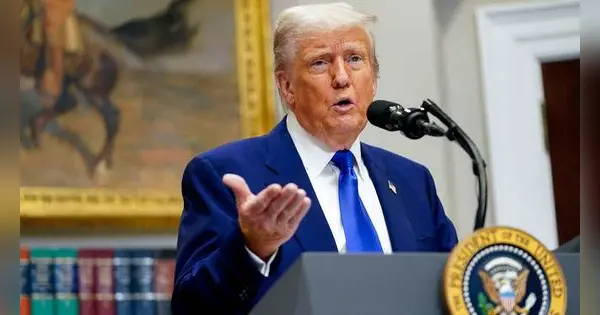
President Trump has been quite public in his criticism of Harvard, accusing this prestigious Ivy League institution of harbouring foreign influence. In a Truth Social post, he noted, “Almost 31 per cent of their students are from foreign lands…. yet those countries, some not friendly to the United States, pay NOTHING toward their student’s education.”
He further berated Harvard’s reliance on government grants despite possessing a whopping $53.2 billion endowment, stating, “We want those names and countries. Harvard has $52,000,000, use it, and stop asking the Federal Government to continue granting money to you.”
This move is part of a larger action by the Department of Homeland Security (DHS), steered by Secretary Kristi Noem. The DHS has barred Harvard from the Student and Exchange Visitor Program (SEVP), jeopardising the legal standing of nearly 6,800 foreign students. Noem has accused Harvard of “fostering violence, antisemitism, and coordinating with the Chinese Communist Party.”
In response, Harvard is pushing back legally. They’ve taken legal action against the Trump administration, declaring the decision “unlawful and unconstitutional.” A federal judge has temporarily blocked this policy, rendering the eventual outcome anything but certain.
Economic implications of the crackdown
International students contribute enormously to the US economy, pouring in over $44 billion in the previous year alone, according to the National Association of Foreign Student Advisers (NAFSA). Harvard, as a particularly popular institution, has been a significant contributor, generating millions through tuition, housing, and local consumption.
Each student reportedly brings an estimated $29,000 annually, thus bolstering not just the university but also local economies. The contributions are quite tangible; for every three international students, one US job is created across sectors like education, housing, retail, and healthcare. In the 2023–24 academic year alone, these students supported around 378,000 jobs.
| Impact Area | Economic Contribution |
|---|---|
| Jobs Supported | 378,000 |
| Annual Student Contribution | $29,000 per student |
| Total Economic Contribution | $44 billion |
Even smaller towns aren’t left untouched. Mankato, Minnesota, a modest community of 45,000 residents, saw $46 million in economic activity thanks to international students, supporting nearly 190 local jobs.
In Cambridge, Massachusetts, where Harvard is situated, the absence of nearly 7,000 students could have significant impacts, affecting real estate, local restaurants, bookstores, transportation, and research collaborations.
Potential ripple effects
The fear is palpable across other institutions as well. Institutions like Arizona State, UC Berkeley, and University of Illinois Urbana-Champaign, which attract tens of thousands of foreign students, reportedly generated $1.7 billion in local economic benefits.
While a federal judge may have paused Trump’s order, the longer-term trajectory is fraught with uncertainty. Should this clampdown be upheld or spread across other universities, the US could stand to lose top-tier international talent, sever a $44 billion economic engine, and tarnish its soft power within global education.
Such moves may well question alignment with the “Make America Great Again” agenda, casting a shadow over America’s standing as a leader in global education. This political dispute could culminate in lasting economic and diplomatic costs, marking a precarious moment for the country.